
 English
 中文简体
 русский
 فارسی
 عربى
 Deutsch
PVC Laminate Emboss Machine: How Bonding, Texture, and Line Planning Work
The question we hear most often about a PVC laminate emboss machine is not about speed or price. It is about sequence: does the texture go on before or after the layers are bonded, and what happens to the printed pattern underneath? It is a fair question, because the answer decides whether a line produces a convincing wood grain or a slightly blurry imitation of one. We have spent close to three decades building decorating equipment in Lin'an, Hangzhou, and this is the explanation we give to a visitor walking the shop floor.
Content
- 1 What a PVC laminate emboss machine actually does
- 2 Lamination and embossing share a frame but not a job
- 3 Station by station through the line
- 4 Why glueless composite matters more than it sounds
- 5 Matching the texture to the print and the end use
- 6 Where the embosser sits in a wider PVC film line
- 7 What to confirm before you specify a line
- 8 A closing note from the shop floor
What a PVC laminate emboss machine actually does
A PVC laminate emboss machine is a continuous line that does three jobs in a single pass. It brings two or three PVC film layers together, bonds them with heat and pressure instead of adhesive, and presses a texture into the surface while the material is still soft enough to hold it. The web is then cooled under tension and rewound as finished decorative film.
The output is the surface most people recognise without thinking about it: the grain on a rigid vinyl floor plank, the matte finish on a furniture panel wrap, the stone texture on a wall panel. Every one of those starts as flat, unremarkable film.
It is tempting to treat the two as one operation because they happen a few metres apart. In practice they have different tolerances. Lamination answers to temperature, pressure and tension; it is a bonding problem. Embossing answers to roll temperature, nip pressure and the hardness of the backing roll; it is a forming problem. When a customer tells us the pattern looks shallow, the cause is as often a bonding station running cool as it is the embossing roll itself.
Keeping those two conversations separate is the difference between a line that can be dialled in over a shift and one that gets adjusted by guesswork for weeks.
Station by station through the line
A glueless composite embossing line is easier to understand as a sequence than as a specification sheet. The table below is the order we usually walk customers through.
| Stage | What happens | What drifts when it is not held |
|---|---|---|
| Unwind and tension | Two or three rolls feed in at matched tension | Wrinkles, edge curl, uneven texture depth |
| Preheating | Film is brought up to bonding temperature | Weak layer bond, hazy print |
| Glueless composite | Heated rolls press the layers together | Air bubbles, separation after storage |
| Embossing | Engraved roll forms the texture in soft film | Shallow or doubled pattern |
| Cooling | Chilled rolls set the texture before winding | Texture flattening inside the roll |
| Coating or top layer | Optional clear layer for scuff resistance | Surface wear during handling |
| Rewind | Finished film wound at controlled tension | Blocking, telescoped rolls |
Not every line has every station. A two-layer structure skips the third unwind, and a line running a protective top layer adds coating before the final rewind. What does not change is that cooling has to happen before winding, or the texture slowly presses itself flat under the weight of the roll.
Why glueless composite matters more than it sounds
Running without adhesive is not only an environmental talking point, although it is a real one: no solvent handling, no adhesive curing, less material to store and dispose of. The practical benefit is gauge control. An adhesive layer adds an unpredictable film between the substrates, and on a thin decorative film that shows up as a slightly hazy print and a softer texture at the same nip pressure.
Glueless bonding relies on the film itself reaching the right temperature at the right moment. That makes preheating and roll temperature control more critical than on an adhesive line, and it makes the cooling section more critical still.
Matching the texture to the print and the end use
Texture is a specification, not a decoration. The same embossing roll behaves differently depending on what it is pressing into and what the finished film has to survive:
- Fine wood grain for furniture and cabinet wraps, where the texture should be felt more than seen.
- Deep, wide grain for flooring planks, where the texture has to hold up under a wear layer and foot traffic.
- Stone and slate effects, which rely more on gloss difference between registers than on physical depth.
- Matte and satin finishes for wall panels and interior films, where glare is the enemy.
Where the film is printed, the emboss roll and the print cylinder have to agree. If the printed wood grain and the pressed grain drift apart, the eye catches it immediately, even at arm's length. We go through the registration side of this on our synchronized texture printing technology page, and the same discipline applies to PVC film as to decorative paper.
Where the embosser sits in a wider PVC film line
The embossing machine is rarely the first or the last machine in a plant. Upstream sits a gravure printer laying down the pattern; downstream sits inspection and rewinding. When the two ends are specified separately, without matching web width, tension profile and line speed, the bottleneck simply moves to whichever machine is slower.
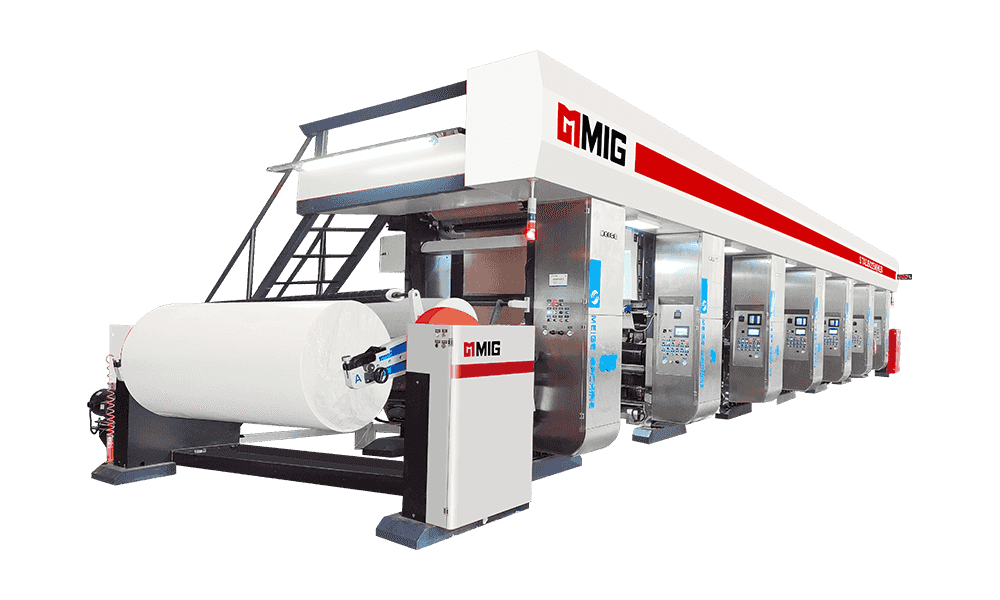
For the printing stage we build the PL series, including the 4-foot high speed ELS-type PVC gravure printer, which is the usual partner for a finishing line of this kind. You can see the family on our PVC decorative film printing page.
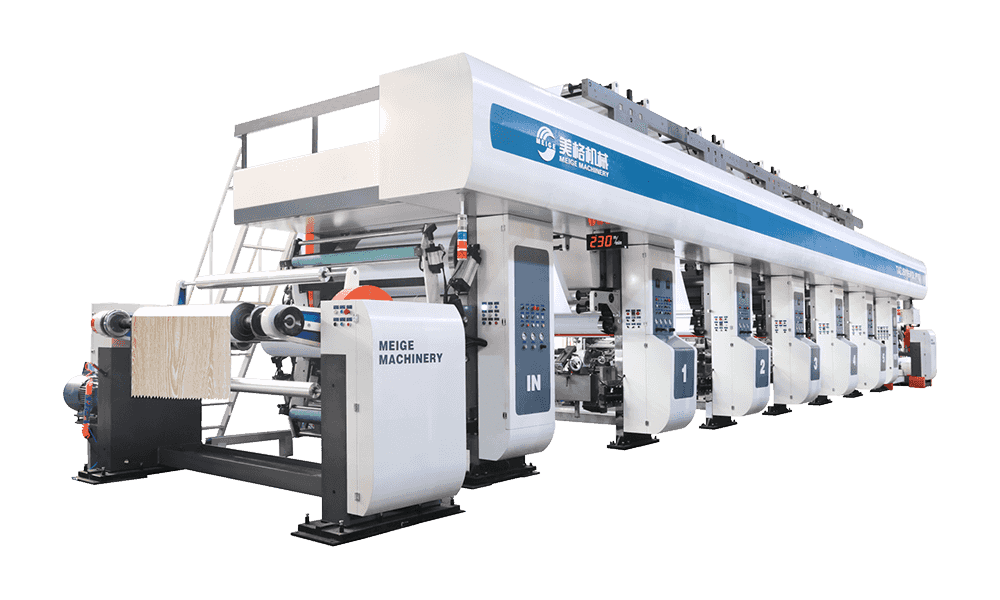 PL800 High-Speed PVC Gravure Printing MachineA 4-foot ELS-type gravure printer from the PL Series, positioned as the printing partner for PVC decorative film finishing lines.View Product →
On the finishing side, the two- and three-layer glueless composite embossing machine is the workhorse for standard decorative film, handling the bonding and the texture in one pass with a compact footprint.
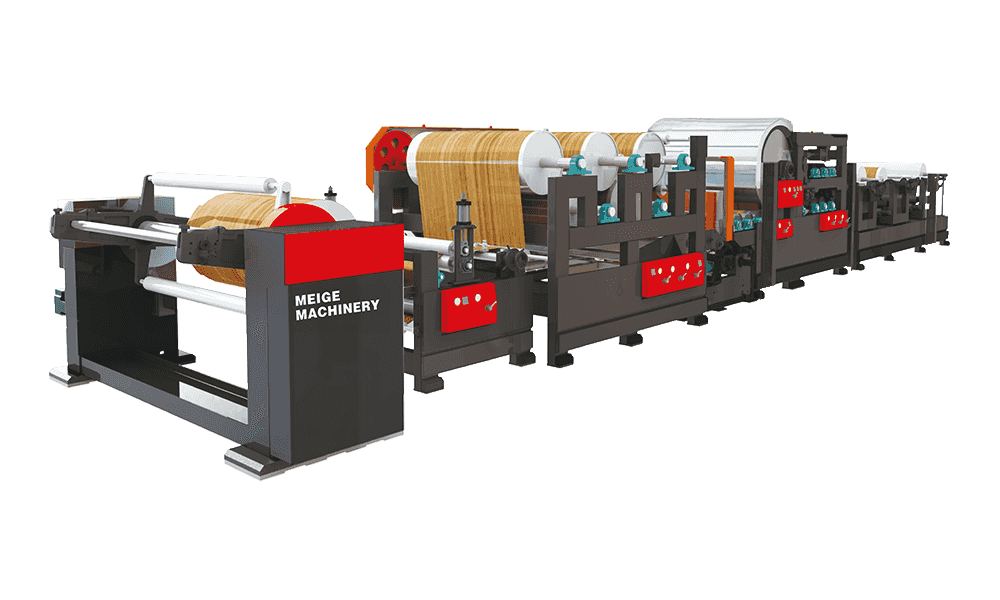 MGFH-1650D-2 Glueless Composite Embossing MachineA two- or three-layer adhesive-free composite embossing machine for standard decorative film, combining bonding and texture in one pass.View Product →
When the film needs a protective layer or an additional coating before the texture goes on, the coating and embossing version adds that station to the same frame instead of a second machine.
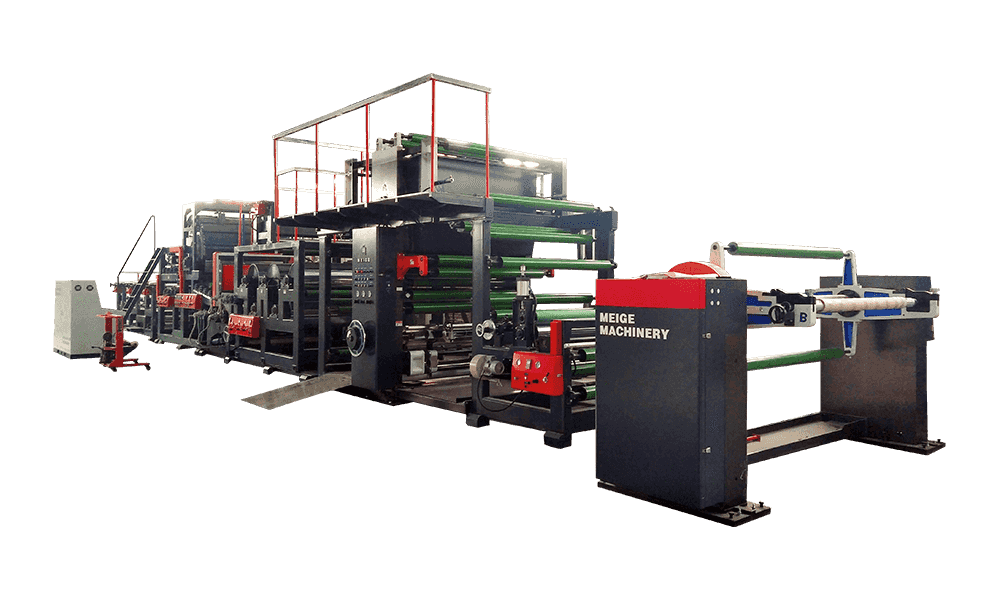 MGFH-1650D-3 Glueless Composite Embossing Coating MachineA 2- or 3-layer protective-layer embossing and coating machine that adds back-coating after embossing within the same integrated frame.View Product →
What to confirm before you specify a line
Most of the expensive surprises in this equipment come from details that were never written down. These are the points worth settling before a quotation is signed:
- Layer count and structure, including whether a protective top layer is part of the finished product or a later step.
- Film thickness range, because the same roll behaves differently on a 0.08 mm film and a 0.30 mm one.
- Texture depth and roll changeover, including how often the pattern changes in a working week.
- Cooling capacity relative to line speed, which is where shallow texture usually originates.
- Speed match with the printer upstream, so the finishing line is not waiting or overrunning.
- Utilities, floor space and roll handling, including how heavy emboss rolls will be moved and stored.
- Who actually runs the line at night, because a machine is only as good as the shift that operates it.
None of these require a technical department to answer. They require an honest picture of what the plant will be making three years from now, not only on the day of installation.
A closing note from the shop floor
We have been building printing and finishing equipment since 1999, and the lines that age well are rarely the most heavily specified ones. They are the ones where the lamination station, the embossing roll and the cooling section were sized for the same job, and where the people running them understand why each station exists. If you are planning a PVC film line, or trying to work out why an existing texture is not holding, that conversation is usually more useful than a brochure.
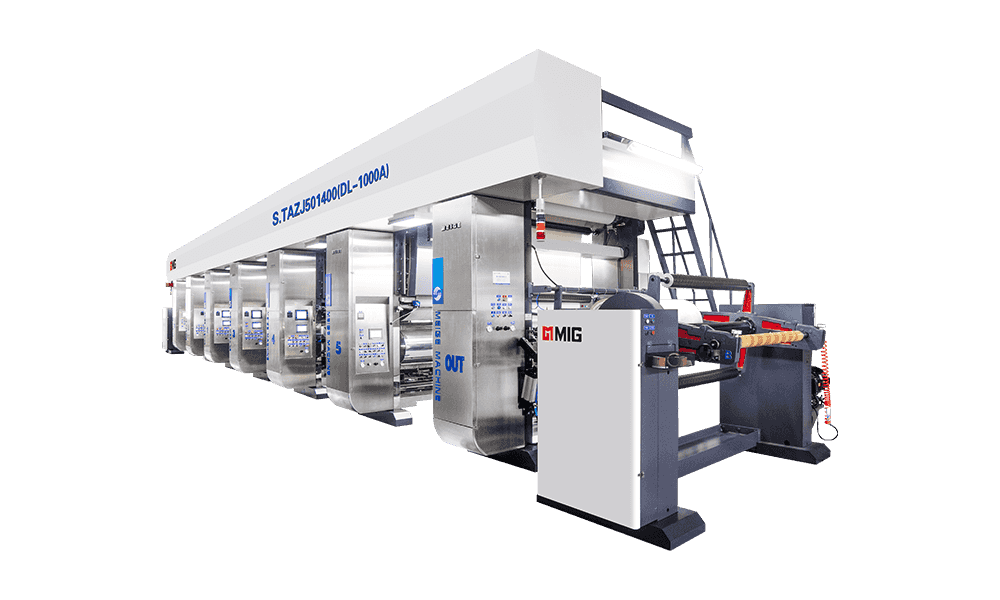
Recommended Products
The variety of models, to meet the development needs of various regions in the world.
Message Us Right Now!
Quick Links
Products
Contact Us
- Phone: +86-13067738802 (Manager Hua)
- Tel: +86-0571-61071715
- Fax: +86-0571-61071706
- Mail: [email protected]
- Add: No.32 Wujiatou, Qingke Village, Jincheng Street, Lin'an District, Hangzhou City, Zhejiang Province

Copyright © Zhejiang Meige Machinery Technology Co., Ltd. All rights reserved.
 Privacy Rotogravure Printing Machine Manufacturers